
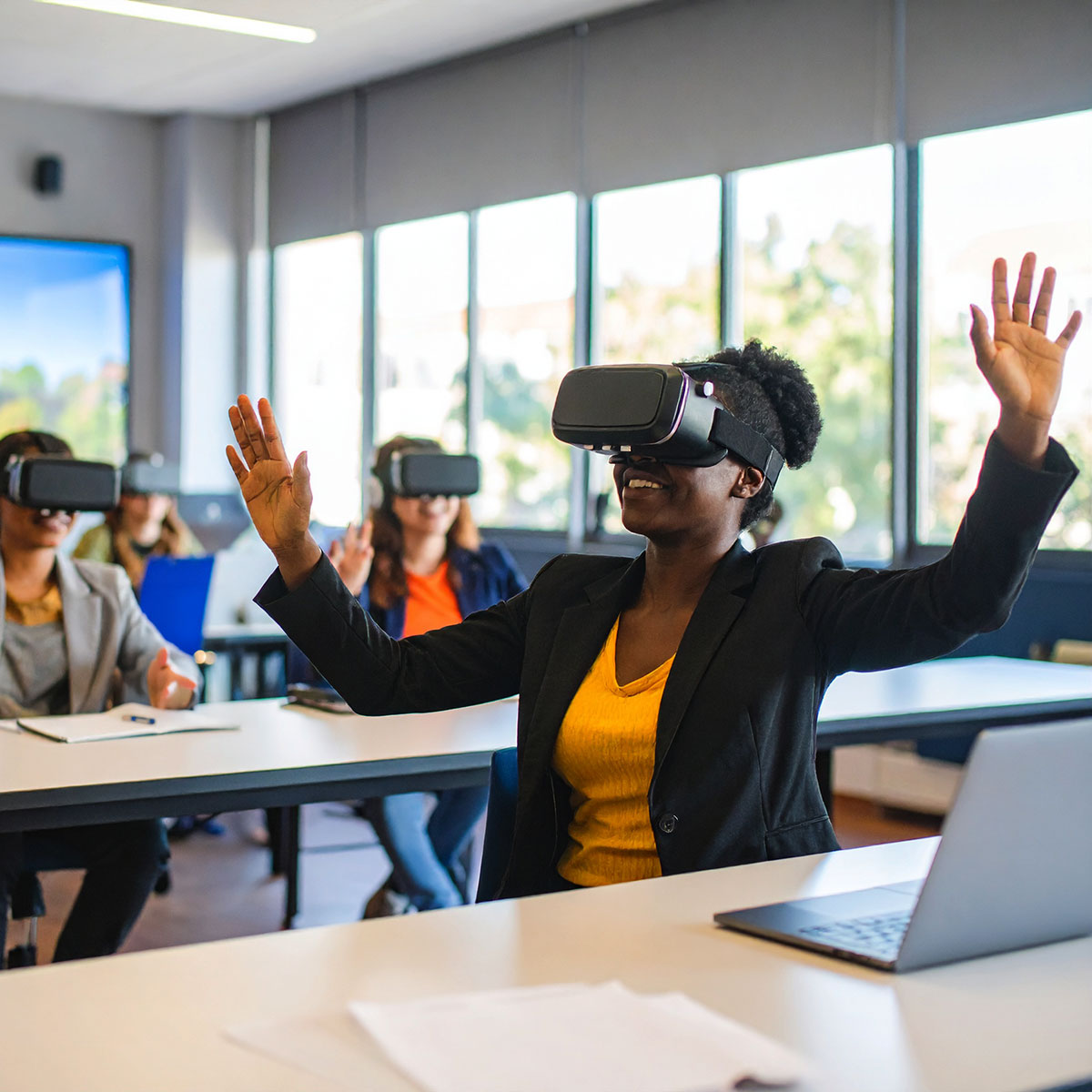
In classrooms around the world, a quiet revolution is underway—one that’s transforming how students learn, interact, and engage with their education. Virtual reality (VR), once the domain of gaming and entertainment, is now emerging as a powerful tool in schools, offering immersive, multisensory experiences that redefine traditional teaching methods. As educators seek new ways to inspire curiosity and deepen understanding, VR presents a new frontier for engagement that’s both exciting and essential.
What Is Virtual Reality in Education?
Virtual reality in education refers to the use of computer-generated environments that simulate real or imagined worlds. With the help of VR headsets and compatible software, students can explore ancient civilizations, dive into the human bloodstream, or walk on the surface of Mars—all without leaving the classroom. These experiences are not passive; they’re interactive, allowing students to manipulate objects, solve problems, and engage with content in ways that traditional textbooks and lectures simply can’t match.
The core elements of VR—presence, interactivity, and immersion—are what make it so effective. Presence allows students to feel as though they’re truly “there,” whether it’s inside a cell or standing at the edge of a volcano. Interactivity encourages curiosity and exploration, while immersion helps students focus and retain information more effectively.
The Impact on Student Engagement
One of the most compelling reasons to integrate VR into schools is its ability to dramatically boost student engagement. According to a 2024 review published in Frontiers in Psychology, VR enhances cognitive, behavioral, and affective engagement in the classroom. Students are more likely to participate actively, stay focused, and express enthusiasm when learning through immersive experiences.
Research shows that VR lessons can increase engagement by up to 80% compared to traditional methods. For example, instead of reading about ancient Egypt, students can virtually walk through the pyramids, examine hieroglyphics, and interact with historical artifacts. This kind of experiential learning makes abstract concepts tangible and memorable.
Improved Retention and Performance
Beyond engagement, VR also improves knowledge retention and academic performance. Studies indicate that learners retain up to 75% more information when lessons involve virtual reality. A PwC study found that VR training can enhance performance by 40%, a benefit that translates well to educational settings.
Schools that have adopted VR into their curricula report noticeable improvements in test scores and comprehension. By allowing students to visualize complex systems—like the circulatory system or planetary motion—VR helps bridge the gap between theory and understanding.
Encouraging Active Learning and Critical Thinking
VR isn’t just about watching—it’s about doing. Through interactive simulations, students become active participants in their learning journey. They can conduct virtual experiments, solve engineering challenges, or collaborate on digital art projects. This hands-on approach fosters critical thinking, creativity, and problem-solving skills.
For instance, Cobb County schools in Georgia have successfully integrated VR into their STEM programs, enabling students to build structures, test hypotheses, and explore scientific principles in virtual labs. These activities promote deeper learning and prepare students for real-world applications.
Accessibility and Inclusivity
Another advantage of VR is its ability to cater to diverse learning styles. Traditional education often relies heavily on auditory and visual instruction, which may not be effective for all students. VR offers a multisensory experience that includes visual, auditory, and kinesthetic elements, making it especially beneficial for students with learning disabilities or attention challenges.
By creating inclusive environments where students can learn at their own pace and in their preferred style, VR helps level the playing field. It also opens up opportunities for students in remote or underserved areas to access high-quality educational experiences that might otherwise be out of reach.
Empowering Educators
VR isn’t just a tool for students—it’s a resource for teachers as well. Educators can use VR to design customized lessons, conduct virtual field trips, and simulate scenarios that would be impossible or impractical in real life. Whether it’s visiting the Louvre, exploring the Great Barrier Reef, or walking through a historical battlefield, VR expands the classroom beyond its physical walls.
Teachers can also use VR to assess student progress in real time, track engagement, and adapt instruction based on individual needs. With the right training and support, educators can harness VR to create dynamic, student-centered learning environments.
Challenges and Considerations
Despite its promise, integrating VR into schools comes with challenges. According to the Frontiers in Psychology review, many education systems struggle to keep pace with VR developments. Teachers may lack the technical proficiency to use VR effectively, and students may need additional support to develop digital literacy skills.
Cost is another barrier. While VR headsets and software have become more affordable, outfitting an entire classroom or school can still be expensive. Schools must also consider infrastructure needs, such as internet bandwidth, device compatibility, and maintenance.
To overcome these hurdles, experts recommend that policymakers invest in teacher training, technical support, and curriculum development. Partnerships with tech companies and educational platforms can also help schools access resources and expertise.
Real-World Examples
Several schools and districts are already leading the way in VR adoption. In the UK, the ClassVR initiative provides schools with ready-to-use VR headsets and lesson plans across subjects like science, history, and literature. In the U.S., districts like Miami-Dade and Los Angeles Unified have piloted VR programs to enhance STEM education and career readiness.
Universities are also exploring VR for teacher training, allowing future educators to practice classroom management and instructional techniques in simulated environments. These innovations demonstrate the versatility and scalability of VR in education.
The Future of VR in Schools
As technology continues to evolve, the potential for VR in education will only grow. Advances in artificial intelligence, haptic feedback, and augmented reality will make virtual experiences even more realistic and interactive. We may soon see classrooms where students use mixed reality to collaborate on global projects, explore virtual ecosystems, or simulate historical debates.
The integration of VR with learning management systems (LMS) and adaptive learning platforms will enable personalized instruction and data-driven insights. Teachers will be able to tailor content to each student’s strengths and challenges, creating more effective and equitable learning environments.
A New Frontier for Engagement
Virtual reality is not a gimmick—it’s a transformative tool that redefines how students learn and engage. By immersing learners in dynamic, interactive environments, VR fosters curiosity, deepens understanding, and makes education more inclusive and exciting. While challenges remain, the momentum is undeniable. Schools that embrace VR today are not just adopting new technology—they’re pioneering a new era of learning.
As we look to the future, one thing is clear: the classroom is no longer confined to four walls. With VR, the world—and beyond—is within reach.
Share This Page: